Time travel is real…
Every so often someone will make a post about Generative AI on Reddit or LinkedIn that seems to be taken wholesale copypasta from 2022 and when they do that it transports back not only to 2022 but also back to the turn of the millennium when all kinds of technological fears about the future were consuming the world over dial-up internet.
If you’re old enough to remember the headlines they were everywhere in 2001, pegged to the release of ‘Final Fantasy: The Spirits Within’, a fully CGI film from Square Pictures that was supposed to usher in a new era. Its lead character, Dr. Aki Ross (400,000 polygons of photorealistic lad-mag ambition) was marketed as the world's first digital actress, with a planned career across multiple future films. Actual journalists at actual publications wrote with apparent sincerity that real actors were an endangered species.
Rick Lyman of the New York Times, "Movie Stars Fear Inroads by Upstart Digital Actors"
Anthony Breznican of Backstage, "'Actress Aki Ross does not exist, but her movie career is blossoming nevertheless. The technology is advancing so fast that computerized avatars--the ultimate in forever-young, trouble-free stars--could eventually compete for roles with flesh-and-blood members of the Screen Actors Guild."
Ruth La Ferla of the New York Times, "Perfect Model: Gorgeous, No Complaints, Made of Pixels" - identified Aki as part of a growing "synthespian" trend about a month before release
Elvis Mitchell of the New York Times, "She's Lovely, But Alas, She's Only Software"
From Synthespian to Avatar: Reframing the Digital Human in Final Fantasy and The Polar Express, "In the months leading up to the July 2001 release of Final Fantasy: The Spirits Within (dir. Hironobu Sakaguchi), nervous stars and journalists speculated that digital actors or "synthespians" could come to replace real, flesh-and-blood Hollywood talent."
Maxim magazine: Aki Ross was ranked #87 on Maxim's Top 100 Hottest Women of 2001 with the following text:
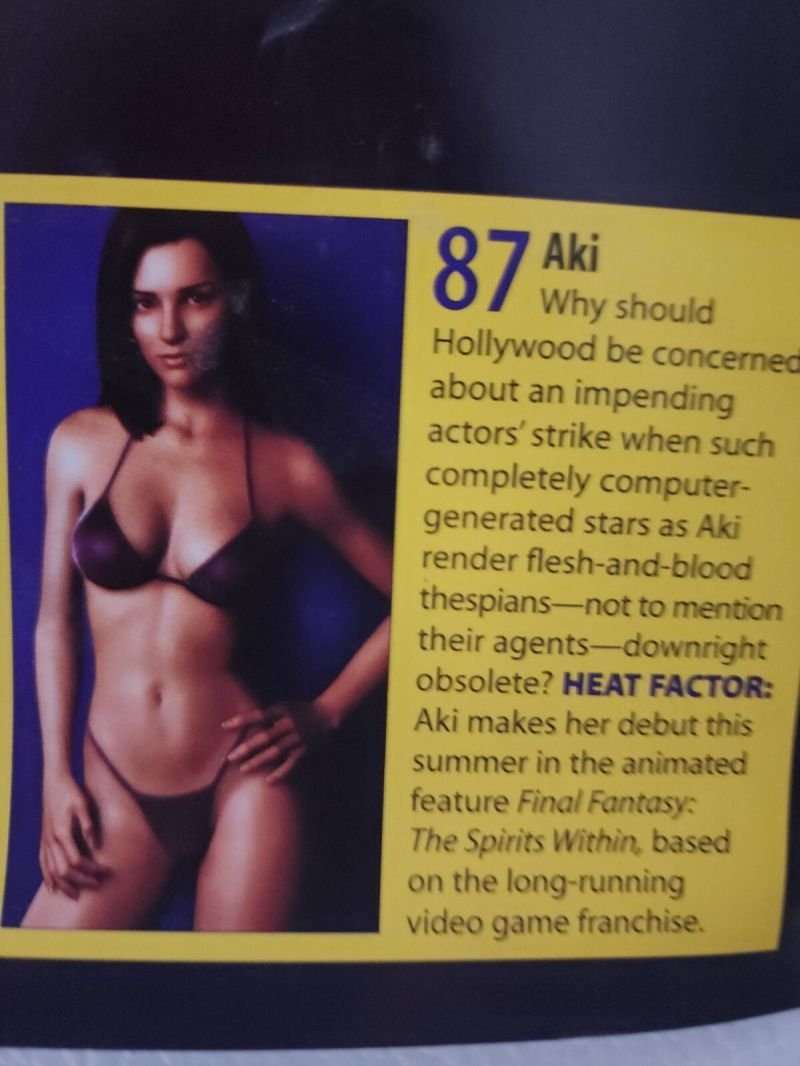
Tom Hanks fretted publicly (he still does). The Screen Actors Guild was in a mild panic (the media claimed).
Aki Ross was supposed to have a multi-picture career performing multiple roles. She never made another film. Square Pictures shut down after the movie lost around $94 million. Actors were fine. And yet here we are, twenty-five years later, with identical headlines swapped out for a new technology and a new scapegoat, doing the rounds on LinkedIn and Reddit. In 2001 it was Aki Ross. In 2025 it was an even blander computer generated demo in the form of Tilly Norwood. I won’t even bother posting an image of this one.
Andrew Niccol of Gattaca fame saw the whole thing clearly enough to make a satire about it the following year - ‘S1m0ne’ (or ‘Simone’) in which Al Pacino played a director who generated a photorealistic digital actress, makes her a star and then couldn’t get rid of her. Think 1984’s ‘Electric Dreams’ but set in Hollywood. It was a comedy, not dystopian science fiction. The joke was that the premise was absurd.
This week I spotted a post on r/vfx that could have been written in 2022, or 2019, or 2001 for that matter. The post was supposed to be a call to arms for the creative industry to rise up against the monster of AI, but the poster didn't get the rally he was looking for. He got pushback and mockery. My reply was a bit more informative than most and the same thing I have been saying for years:
"There have been countless posts like this over the last three years. The fears are baseless (I am trying to make you hopeful but fear mongers are active on the forums and downvote optimistic posts). The industry isn't going anywhere. We will just see more diversification, more channels, more choices, more independents mashing up old and new methods.
In the 90s they said 3D CGI was going to replace all actors by 2010. Andrew Niccol made an AI satire called 'Simone' making fun of these predictions. The predictions from the doomers didn't come true. We're still finding it hard to get convincing photorealism in 2026.
Three years ago they said Sora was going to destroy the film industry. Sora didn't fix most of their hallucinations and errors and neither did their competition Veo, Kling, Seedance, etc. If you look past the demo videos and marketing videos and use them yourself they are frustrating, not broadcast quality and you end up losing a lot of productive time. Today Sora is no more.
Take another example — Suno. Two years ago, even one year ago, it was a music generator. The media and the AI hype men breathlessly reported that this was going to kill music and musicians will be replaced. What does it look like today?
If you log into Suno's app today it is a social network full of REAL indie musicians. Some of them use Suno's models to fine tune their acoustic and electronic performances. Some of them use Suno to add vocals to their acoustic performances because they don't have money for a real singer. Some of them are small businesses who need generated elevator music behind their product videos. I knew they would build a social network but I didn't expect to see so many real musicians, comedians and small businesses so soon.
So looking past slop and spam, that's what we are going to see image/video/vfx wise. Just additional choices for creating and editing imagery. On this sub two years ago some agreed with that and said it was actually the stock libraries that would get less traffic, but we see the popular stock libraries jump on the AI train and offer generative options.
It's a planet with 8 billion people and that means there was always a larger market that was never addressed. Identifying all the new channels and avenues is the trick. For example, how do we get all those millions of people who pirate movies to watch mash up/generated/indie content? Can it be monetised? Can short form videos and AI create a career for Indies who will never be able to get a foot in the film industry?"
The template
The template is always identical:
Breathless "X will replace Y" headline
Quote from a nervous celebrity
Framing of inevitability ("it's coming")
The technology treated as a threshold moment
A specific face/product used as the emblem of the threat
Find an impressive demo. Quote a nervous celebrity. Frame the technology as a threshold - the last generation of human creators, the point of no return. Run the headline as a question for plausible deniability. Collect the clicks. Move on before the reality catches up.
The template has been applied so many times it has worn grooves in the floor. Desktop publishing was going to kill graphic designers. Programmed synths were going to kill classically trained musicians. YouTube was going to kill cinema. Netflix was going to kill television. CGI was going to replace all traditional animation.
No new technology completely displaces what came before it. Classical instruments weren't killed by synthesisers. Ebooks didn't kill books. Streaming didn't kill vinyl - vinyl outlived the iPod. The best directors in the world still shoot on film. Things co-exist. Tools accumulate. Markets expand.
What actually happens
The pattern is consistent. A new tool arrives, genuinely impressive in controlled conditions. The press and the hype cycle treat the demo reel as the finished product and extrapolate to extinction. Then the tool meets reality - the hallucinations, the quality gaps, the compute costs, the sheer difficulty of replacing human judgment at scale - and it finds its actual place, which is usually as an additional option rather than a replacement.
Sora was going to destroy the film industry. Sora is gone. The tools that remain are, if you actually use them rather than watch the marketing reels, frustrating and inconsistent, nowhere near broadcast quality in 2026. Useful for specific things. Not a substitute for a director or a colourist or a VFX artist who knows what they're doing.
Suno was going to kill music. Instead it became a social network where real indie musicians use it as one instrument among many. The musicians are still there. There are just more of them now, with more options.
Stock libraries were supposedly doomed. They added generative features and carried on.
The industry doesn't disappear. It absorbs, adapts, and diversifies. At the end of the day audiences and consumers decide what succeeds. You can have the most outrageous technology in the world but if the content doesn't connect with people it won't sell. Readers want to connect with real authors. Viewers pay to watch actors. That isn't changing because a demo video impressed someone on LinkedIn.
The better questions aren't in any of those headlines. How do independent creators who could never get a foot in the door use these tools to build something that didn't exist before? How do you reach and monetise the audience that's currently pirating content? Where are the eight billion people who were never being served by the existing industry? What new channels are opening that nobody has mapped yet?
Those questions are harder. They don't fit on a panic headline or generate the same engagement as "Is it all over for [insert job title of your choice, reader]?”